What Is Glass Grit Sandblasting? Process, Uses, and Benefits
January 12, 2026
What Is Glass Grit Sandblasting? Process, Uses, and Benefits
In abrasive blasting, surface appearance alone is not enough. Performance, coating adhesion, and part longevity often depend on choosing the right media. Glass grit sandblasting occupies a precise middle ground between aggressive material removal and delicate surface finishing. It delivers controlled abrasion that cleans efficiently without excessive base material loss, making it a dependable option when consistency and surface integrity matter. In industrial surface preparation environments, Kramer Industries works with applications where this balance between control and performance is critical.
Unlike traditional sand or slag abrasives, this abrasive method offers predictable cutting behavior. It is more assertive than glass beads but far less destructive than mineral sand. This balance allows operators to remove coatings, oxidation, and light corrosion while maintaining tight tolerances and minimizing surface distortion.
Understanding the Glass Grit Sandblasting Process
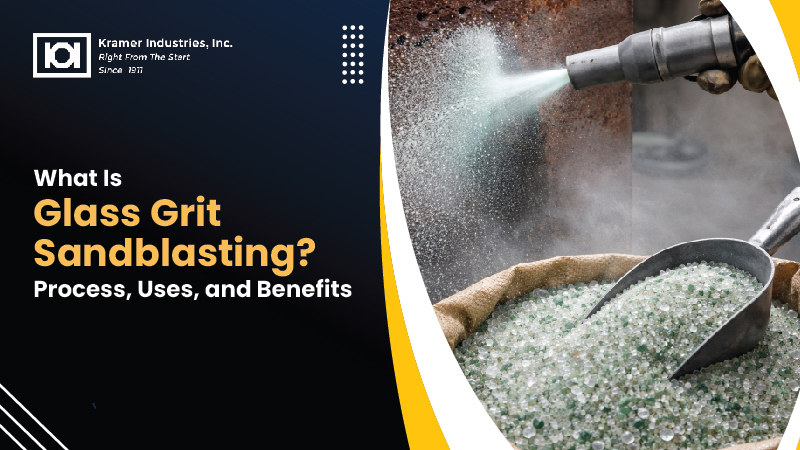
Glass grit is manufactured by crushing recycled glass into sharp, angular particles. That angular structure is what defines its performance. Rather than peening the surface like spherical beads, glass grit cuts into contaminants and coatings, creating a clean, evenly textured profile.
During the blasting process, compressed air accelerates the media toward the workpiece. The abrasive action removes paint, scale, and surface buildup while leaving a consistent matte finish. Operators can fine-tune aggressiveness by adjusting grit size, air pressure, nozzle distance, and dwell time. This level of process control is commonly evaluated by Kramer Industries when optimizing blasting parameters for different substrates and finish requirements.
Because the cutting action is controlled, this process reduces the risk of warping thin materials or removing excess base metal. That predictability is especially valuable in applications where dimensional accuracy and surface quality must be preserved.
Where Glass Grit Sandblasting Performs Best
Glass grit sandblasting is widely used across manufacturing, fabrication, and maintenance environments. In metalworking applications, it effectively strips paint, coatings, and light rust from steel, stainless steel, and aluminum. The resulting surface profile supports strong coating adhesion without creating an overly aggressive anchor pattern.
Automotive and aerospace operations often rely on this non-metallic abrasive when contamination control is required. Because the media does not introduce ferrous residue, it is well suited for stainless steel and aluminum components where surface cleanliness is critical. These contamination-sensitive applications are frequently reviewed by Kramer Industries when assessing abrasive selection for high-spec finishing environments.
Maintenance and restoration professionals also use glass grit sandblasting for equipment refurbishment, mold cleaning, and tool maintenance. It removes buildup efficiently while protecting the underlying surface, extending component life and reducing the need for rework.
Practical Benefits in Production Environments
One of the primary advantages of glass grit sandblasting is control. Compared to silica sand, glass grit cuts efficiently at lower pressures, which helps reduce cycle times without damaging parts. This improves productivity while maintaining consistent quality.
Surface uniformity is another key benefit. This blasting method produces a repeatable, even finish that supports reliable coating and sealing performance. For operations that depend on consistent surface profiles, this reliability reduces variability and downstream issues.
From a safety and environmental standpoint, glass grit offers additional advantages. It contains no free silica, reducing health risks associated with airborne dust. Because it is commonly made from recycled glass and can often be reclaimed for multiple uses, it also supports cleaner and more sustainable blasting operations.
Glass Grit Sandblasting vs. Glass Bead Blasting
Although the two are sometimes confused, glass grit sandblasting and glass bead blasting serve different purposes. Glass beads are spherical and primarily used for peening, surface smoothing, and cosmetic finishing. They improve appearance but are not designed for coating removal.
Glass grit sandblasting is intended for cutting and surface preparation. When the goal is to remove paint, oxidation, or contaminants and prepare a surface for coating, glass grit is the more effective and efficient choice.
Selecting the Right Grit Size
Choosing the correct grit size is essential to getting the best results from glass grit sandblasting. Coarser grits remove material faster and create a more pronounced texture, while finer grits deliver smoother finishes with minimal material removal. Matching grit size to the substrate and desired outcome helps protect equipment, reduce waste, and maintain surface quality.
Conclusion
Glass grit sandblasting provides a reliable balance between cleaning power and surface protection. Its angular structure enables efficient material removal, while its non-metallic composition minimizes contamination and reduces health risks. For operations that require clean, uniform surfaces without aggressive over-processing, this abrasive solution remains a versatile and dependable option.
For manufacturers evaluating abrasive performance and surface preparation methods, Kramer Industries applies real-world finishing experience to help ensure consistent, reliable blasting outcomes across demanding applications.
Comments
Post a Comment